
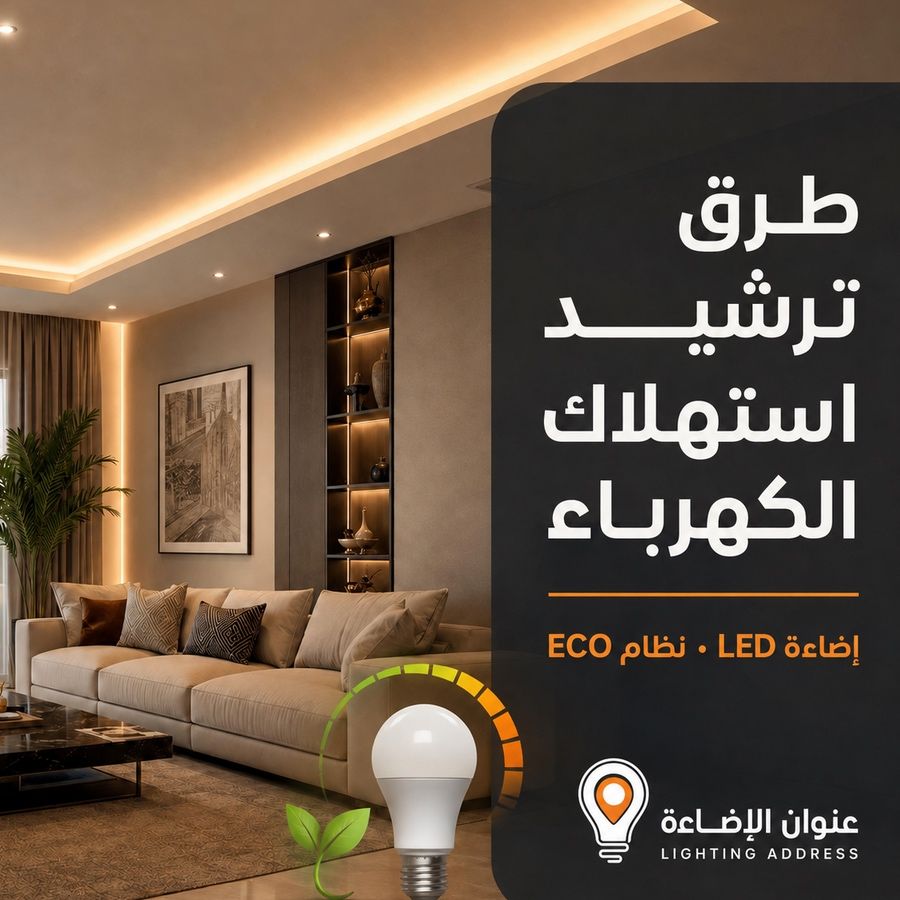
How to Reduce Electricity Consumption at Home with LED Lighting and the Lighting Address ECO System
Reducing electricity consumption has become an essential part of modern life, especially as homes, offices, schools, and commercial projects increasingly depend on artificial lighting.
However, saving electricity does not mean reducing comfort or living in a poorly lit space. It means achieving the right lighting level with lower energy consumption and greater efficiency.
At Lighting Address, we believe that lighting is more than a product. It is an essential element in improving quality of life across homes, schools, offices, retail spaces, and commercial projects.
That is why we provide energy-efficient and environmentally responsible lighting solutions designed to reduce unnecessary consumption while improving visual comfort and lighting quality.
Energy-efficient LED technology is one of the most effective ways to reduce lighting-related electricity consumption, especially when combined with proper lighting design and smart control systems.
This guide explains how to save electricity through lighting, how much LED lighting can save, and how the Lighting Address ECO System combines efficiency, control, and optimized lighting distribution.
What Does Reducing Electricity Consumption Mean?
Reducing electricity consumption means using energy intelligently and efficiently without compromising lighting quality or user comfort.
Effective energy conservation is not limited to switching lights off. It depends on several essential factors:
- Choosing high-efficiency, energy-saving LED lighting.
- Using the correct number of lighting fixtures.
- Distributing light properly throughout the space.
- Controlling operating hours and brightness levels.
- Using smart controls in suitable areas.
At Lighting Address, we believe that genuine energy conservation begins with:
The right product + the right lighting design + intelligent use
A customer may purchase energy-efficient LED lights but still consume unnecessary electricity by installing more fixtures than needed or leaving them operating for long periods.
The best results are achieved when efficient products are combined with proper planning and responsible use.
Lighting Address’s Commitment to Energy Efficiency and the Environment
At Lighting Address, we pay close attention to the details that influence lighting efficiency and energy consumption.
We continually develop solutions designed to:
- Reduce electricity consumption in homes and projects.
- Provide products that comply with applicable Saudi standards and regulations.
- Support environmentally responsible lighting.
- Help reduce carbon emissions through efficient LED products.
- Improve lighting quality in homes, schools, offices, and commercial projects.
- Reduce unnecessary energy waste.
- Extend product life and reduce frequent replacements.
We do not simply provide lighting products. We offer sustainable lighting solutions that aim to improve everyday quality of life while reducing energy consumption.
How Much Electricity Can LED Lighting Save?
LED lighting consumes considerably less electricity than traditional lamps while producing the same amount of light—or more.
According to the , LED lighting can use up to 90% less energy and last significantly longer than traditional incandescent bulbs.
The actual saving achieved in each home or project depends on:
- The efficiency of the LED product.
- The wattage of the old and new lamps.
- The number of lighting fixtures.
- Daily operating hours.
- Lighting distribution.
- Beam angle.
- Required brightness.
- The quality of the lighting design.
A Practical LED Energy-Saving Example
Assume that a home uses ten traditional 60-watt lamps for five hours every day.
The lamps are replaced with ten 9-watt LED lamps that provide a similar level of brightness.
Description
Traditional Lamps
LED Lamps
Number of lamps
10
10
Wattage per lamp
60W
9W
Total connected load
600W
90W
Daily operating time
5 hours
5 hours
Daily consumption
3 kWh
0.45 kWh
Approximate annual consumption
1,095 kWh
164 kWh
In this example, the estimated annual saving is approximately 931 kWh, representing a reduction of around 85% in the electricity consumption of these lamps.
The financial saving can be estimated by multiplying the electricity saved by the tariff applied to the customer’s account.
These figures are illustrative. Actual results may vary depending on product efficiency, operating hours, and usage patterns.
Do Not Choose Lighting Based on Wattage Alone
One of the most common mistakes when buying lighting is asking only: “How many watts is it?”
Wattage measures the amount of electricity consumed, but it does not tell you how much light the product produces.
A correct comparison should consider:
- Watts: the electricity consumed by the product.
- Lumens: the amount of visible light produced.
- Luminous efficacy, measured in lm/W: the amount of light produced per watt of electricity.
For example, two LED products may both consume 10 watts. However, the first may produce 700 lumens while the second produces 1,000 lumens.
Although their electricity consumption is similar, the second product provides more light and has better luminous efficacy.
At Lighting Address, we guide customers to compare lumens, watts, and luminous efficacy together, rather than relying on wattage alone.
The Lighting Address ECO System
The ECO System is an integrated Lighting Address approach designed to achieve better lighting with lower electricity consumption.
ECO consists of three main principles:
E — Efficient Lighting
The first step is selecting efficient LED products that produce the required amount of light while consuming less electricity.
Important product information includes:
- Lumen output.
- Wattage.
- Luminous efficacy.
- Expected operating life.
- Component quality.
- Lighting stability.
- Color consistency.
- Suitability for the intended application.
- Warranty and product support.
An energy-efficient product should not simply consume fewer watts. It should provide the required brightness and maintain its performance over time.
C — Control
Even an energy-efficient product will waste electricity if it remains switched on when it is not needed.
The Control principle reduces unnecessary operation through:
- Smart switches.
- Motion sensors.
- Timers.
- Remote-control systems.
- Mobile applications.
- Lighting schedules.
- Compatible LED dimmers.
- Separate lighting circuits.
Smart controls allow customers to operate only the lights they need and switch them off automatically when the space is no longer in use.
O — Optimization
Optimization means achieving the required lighting result with the correct number of fixtures and the most effective distribution.
It includes:
- Calculating the lighting needs of each space.
- Selecting the appropriate beam angle.
- Identifying activity and furniture locations.
- Directing light toward the required areas.
- Reducing unnecessary lighting.
- Making use of natural daylight.
- Selecting fixtures according to ceiling height and room size.
The ECO System is therefore not a single product. It is an integrated approach that combines efficient lighting, intelligent control, and optimized distribution.
The Role of the Lighting Address Team in Energy Conservation
Lighting Address’s role is not limited to selling a lamp or lighting fixture.
Our team helps customers select practical lighting solutions based on the actual requirements of each space.
Our guidance includes:
- Studying the lighting requirements of the space.
- Explaining the difference between lumens and watts.
- Selecting energy-efficient LED products.
- Determining the appropriate number of fixtures.
- Choosing a suitable color temperature.
- Selecting the correct beam angle.
- Planning lighting distribution.
- Dividing lighting into separate control circuits.
- Recommending smart switches, sensors, and timers.
- Comparing products according to efficiency, performance, and quality.
- Avoiding unnecessary spotlights or excessive brightness.
Our goal is not simply to sell more lighting fixtures. It is to provide the customer with comfortable, attractive, and effective lighting using the lowest suitable level of electricity consumption.
Practical Ways to Reduce Electricity Consumption Through Lighting
1. Replace Traditional Lamps with LED Lighting
Start with lamps that operate for the longest periods, such as those used in:
- Living rooms.
- Kitchens.
- Hallways.
- Offices.
- Entrances.
- Outdoor areas.
- Commercial spaces.
It is not always necessary to replace every lamp at once. Begin with the highest-wattage and most frequently used lamps to achieve faster savings.
2. Select the Correct Lumen Output
Lighting that is weaker than required may force the customer to install additional fixtures.
Lighting that is excessively bright can increase electricity consumption and create uncomfortable glare.
The correct lumen requirement depends on:
- Room size.
- Ceiling height.
- Type of activity.
- Wall and floor colors.
- Beam angle.
- Natural light.
- Other lighting sources.
3. Improve Lighting Distribution
Installing more spotlights does not always produce better lighting.
A smaller number of efficient fixtures with the correct lumen output and beam angle may provide better coverage than a large number of low-quality units.
Before installation, consider:
- Furniture locations.
- Seating areas.
- Work surfaces.
- Walking paths.
- Television screens.
- Decorative walls.
- Artwork and architectural features.
4. Divide Lighting into Separate Circuits
Connecting every light in a room to a single switch often causes unnecessary consumption.
Lighting can be divided into:
- General lighting.
- Concealed lighting.
- Decorative lighting.
- Wall lighting.
- Television-area lighting.
- Dining-area lighting.
- Task lighting.
This allows customers to switch on only the lighting they need.
5. Use Motion Sensors
Motion sensors are especially useful in spaces used for short periods or where lights are often left on accidentally.
Suitable locations include:
- Hallways.
- Bathrooms.
- Storage rooms.
- Staircases.
- Warehouses.
- Entrances.
- Selected outdoor areas.
The sensor activates the light when movement is detected and switches it off after a preset period.
6. Use Smart Switches and Smart Lighting
Smart lighting systems allow users to control lights through mobile applications, voice commands, schedules, or automated scenes.
They can be used to:
- Switch off all lights when leaving home.
- Set operating schedules.
- Check lighting status remotely.
- Create different lighting scenes.
- Reduce brightness when full illumination is unnecessary.
- Control individual rooms or areas.
Smart products should be selected according to system compatibility and installed correctly.
7. Use Compatible LED Dimmers
Dimmers allow customers to reduce brightness when full light output is not required.
They are useful during:
- Television viewing.
- Relaxed evening settings.
- Dining.
- Bedroom use.
- Decorative lighting scenes.
Before installing a dimmer, confirm that:
- The LED fixture is dimmable.
- The dimmer is compatible with LED technology.
- The electrical load is suitable.
- Installation is performed by a qualified technician.
An incompatible dimmer may cause flickering, noise, unstable performance, or a shorter product life.
8. Make Better Use of Daylight
Natural daylight can reduce the need for artificial lighting during the day.
Useful practices include:
- Opening curtains and blinds.
- Positioning work areas near windows.
- Avoiding furniture that blocks natural light.
- Using light-colored walls and surfaces.
- Using mirrors and reflective materials appropriately.
9. Clean Lighting Fixtures Regularly
Dust collecting on lamps, lenses, and fixtures can reduce the amount of light reaching the space.
Regular cleaning, after safely disconnecting the power and following the product instructions, helps maintain lighting performance and may reduce the need to operate additional fixtures.
10. Control Outdoor Lighting
Garden, façade, and entrance lighting may continue operating long after it is needed.
Outdoor consumption can be managed through:
- Timers.
- Photocell sensors.
- Smart switches.
- Scheduled operation.
- Separate lighting circuits.
- Motion sensors in suitable areas.
11. Select the Correct IP Rating
Using an indoor product in an outdoor or wet location may cause premature failure and frequent replacement.
The appropriate IP rating should be selected for:
- Gardens.
- Building façades.
- Bathrooms.
- Washing areas.
- Dusty locations.
- Areas exposed to rain or water.
Selecting the right product helps preserve system efficiency and reduces replacement and maintenance costs.
Does Light Color Affect Electricity Consumption?
Color temperature—such as 2700K, 3000K, 4000K, or 5000K—describes the appearance of light from warm to cool white.
Color temperature alone does not determine electricity consumption.
Two lamps can have the same color temperature while differing in:
- Wattage.
- Lumens.
- Luminous efficacy.
- Component quality.
- Beam angle.
The color temperature should be selected according to the atmosphere and function of the space, while energy efficiency should be evaluated through lumens, watts, and luminous efficacy.
What Should You Check Before Buying an LED Product?
Before purchasing an LED lamp or lighting fixture, review:
- Wattage.
- Lumen output.
- Luminous efficacy.
- Color temperature.
- Beam angle.
- Color Rendering Index (CRI).
- Declared operating life.
- Dimming compatibility.
- IP rating when required.
- Voltage and frequency.
- Warranty.
- Energy-efficiency and conformity information for regulated product categories.
A lower purchase price does not always mean better value.
A low-quality product may produce less light, lose performance quickly, flicker, or require frequent replacement.
Lighting Products That Comply with Saudi Standards
Several lighting product categories in Saudi Arabia are subject to energy-efficiency, performance, and labeling requirements.
The lists lighting products among the categories covered by energy-efficiency standards, including:
- SASO 2870 for lighting products — Part One.
- SASO 2902 for lighting products — Part Two.
- SASO 2927 for lighting products — Part Three.
Energy-efficiency labels aim to:
- Help customers understand product efficiency before purchase.
- Reduce energy consumption.
- Preserve national resources.
- Support consumer and environmental safety.
At Lighting Address, we are committed to providing lighting products that comply with the applicable Saudi standards, technical requirements, and regulations.
We also focus on reviewing product specifications and tests and providing customers with the information they need before making a purchasing decision.
Real energy savings are not achieved simply because the word “LED” appears on the packaging. They require a reliable product that delivers verified performance and appropriate efficiency.
A Practical ECO Plan for Your Home
The ECO approach can be implemented in five simple stages:
Stage One: Audit
Record the number of lamps, the wattage of each lamp, and the daily operating hours.
Stage Two: Prioritize
Begin with the lamps that have the highest wattage and longest operating hours.
Stage Three: Replace
Replace traditional products with efficient LED units that provide the required lumen output.
Stage Four: Control
Add smart switches, sensors, timers, or dimmers where appropriate.
Stage Five: Review
Monitor electricity consumption, compare bills, and confirm that the lighting quantity and distribution match actual usage.
How to Calculate Lighting Electricity Consumption
Use the following formula:
Monthly consumption in kWh = Number of fixtures × Fixture wattage × Daily operating hours × 30 ÷ 1,000
Example:
10 lamps × 9 watts × 5 hours × 30 days ÷ 1,000 = 13.5 kWh per month
To estimate the cost, multiply the result by the electricity tariff applied to your account.
Common Mistakes That Reduce LED Energy Savings
- Buying lighting based on wattage alone.
- Installing too many spotlights without a lighting plan.
- Choosing products with low luminous efficacy.
- Leaving lights on in unused spaces.
- Connecting all lights to a single switch.
- Using an incompatible dimmer.
- Installing indoor products outdoors.
- Ignoring warranty and conformity information.
- Mixing different color temperatures without a design purpose.
- Using narrow beam angles for general lighting and compensating with more fixtures.
Conclusion
Reducing electricity consumption through lighting does not mean sacrificing comfort or living with insufficient light.
It means using the right light, in the right place, at the right time.
The process begins with high-efficiency LED products, followed by calculating the required lumen output, selecting the correct number of fixtures, improving distribution, separating control circuits, and using sensors and smart switches where appropriate.
Through the Lighting Address ECO System, we combine:
- Efficient Lighting: Reliable, energy-efficient lighting products.
- Control: Smart and flexible lighting management.
- Optimization: Improved lighting distribution and usage.
At Lighting Address, we help customers select lighting solutions that comply with applicable Saudi standards and provide the required lighting quality without unnecessary energy consumption or excessive numbers of fixtures.
For lighting guidance tailored to your space, visit your nearest Lighting Address branch, shop through our online store, or contact us on our unified number: 8001188889.